

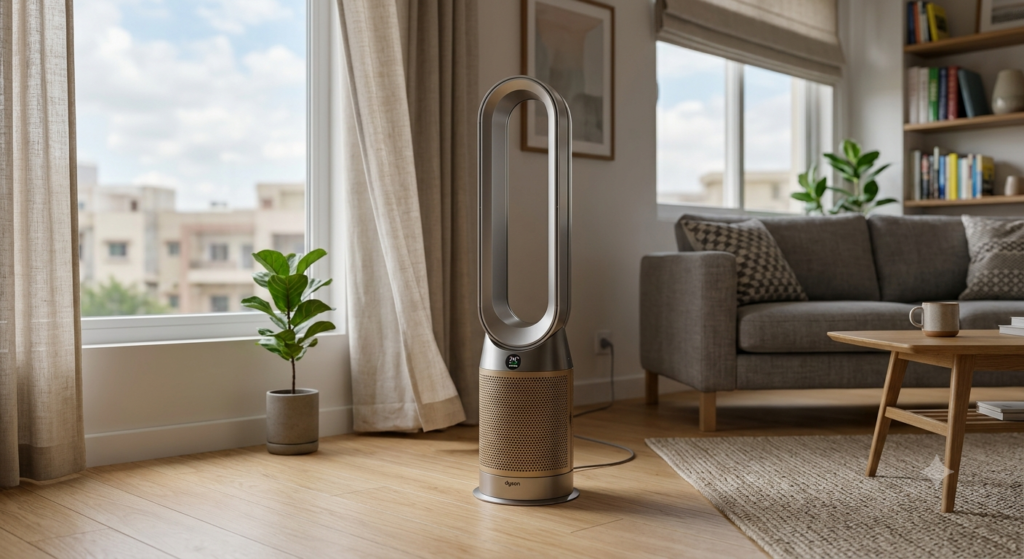
Dyson Fan If you have ever stared at a traditional blade fan caked in dust and wondered why we are still using 19th-century technology to cool our homes, you are not alone. James Dyson thought the exact same thing, which led to the creation of the Dyson fan. Stripping away the chopping blades and ugly safety grilles, the iconic Dyson fan line rewrote the rules of home climate control by introducing a sleek, loop-shaped aesthetic that looks more like modern sculpture than a household appliance.
Choosing a Dyson fan is about investing in a highly optimized microclimate for your living space. These machines do not just push air across the room; they slice, process, and condition it using physics-driven fluid dynamics. Over the years, the classic Dyson fan evolved from a simple desk accessory into an all-in-one smart environmental hub capable of purfying your air, tracking your movements, and adjusting temperature variations on the fly.
Understanding how a Dyson fan operates requires looking past the empty loop. The secret lies in a combination of high-grade engineering and invisible airflow mastery. If you are ready to upgrade your home comfort, let’s pull back the curtain on how a Dyson fan actually works, what the current lineup brings to the table, and how to spot the perfect model for your home.
How Does a Dyson Fan Actually Work Without Blades?
The most common question people ask when looking at a blade-free Dyson fan is: “Where is the air coming from?” The answer is a brilliant engineering trick called Air Multiplier technology. While the loop looks completely empty, a high-efficiency brushless digital motor is spinning fast at the base of the unit. This hidden motor draws in massive amounts of air through intake vents, compressing it and forcing it upward into the hollow amplifier ring.
Once the air reaches the loop, it escapes through a microscopic, 1-millimeter slit running along the inner rim. This creates a high-velocity jet stream of air that shoots forward over an airfoil-shaped ramp, similar to an airplane wing. As this air rushes out, it triggers a physical phenomenon known as inducement and entrainment, which pulls the surrounding air into the stream and amplifies the overall volume up to fifteen times over.
[ Ambient Air Drawn Into Base ] —> [ Brushless Compressor Motor ]
|
v
[ Broad, Smooth Airflow ] <— [ 1mm Inner Slit Over Airfoil Ramp ]
Because there are no physical blades chopping the air into chunky buffers, a Dyson fan delivers a continuous, perfectly smooth ribbon of cool air. Traditional fans create a buffeting effect that feels like getting slapped repeatedly by tiny pockets of wind. A Dyson fan avoids this entirely, creating a natural, whisper-quiet breeze that mimics an outdoor draft.
The Evolution of the Dyson Fan Lineup
The Dyson fan family has branched out significantly from the standalone cooling rings of the early days. Today, you will find multifunctional monsters like the Dyson Purifier Cool and the Dyson Purifier Hot+Cool. These advanced models do double and triple duty by acting as powerful space heaters and sealed HEPA air purifiers that scrub 99.97% of airborne allergens, microscopic dust, and volatile organic compounds (VOCs) out of your living spaces.
The engineering keeps pushing forward, especially with the introduction of AI-powered features like the Find+Follow™ tracking system. This technology utilizes a localized, highly secure 17-point sensor matrix to detect human presence inside a room. Instead of mindlessly oscillating across an empty space, the Dyson fan automatically swings its airflow directly toward you, optimizing your comfort while slashing unnecessary energy consumption.
For massive living spaces or open-concept floor plans, specialized units like the Dyson Purifier Big+Quiet completely rethink the physical footprint of air management. Using aerodynamic HushJet technology, these large-format air hubs mix and project clean air up to 32 feet across a room while operating at a near-silent 24 decibels. Whether you need a compact desk companion or a whole-house air purifier, there is a dedicated configuration tuned for your exact square footage.
Quick Facts and Specifications Table
When comparing different variations of the modern Dyson fan ecosystem, having a clear look at dimensions, filtration capabilities, and target environments makes all the difference. The table below breaks down the primary specifications for the current lineup.
| Model / Type | Core Technology | Best For | Noise Level | Key Highlight |
| Dyson Cool (CF1 / AM07) | Air Multiplier | Desk & Floor Cooling | 42 dB – 64 dB | Safe, blade-free airflow |
| Dyson Purifier Cool | HEPA H13 + Carbon | Medium Bedrooms | 46 dB (Max) | Captures 99.97% of pollutants |
| Dyson Purifier Hot+Cool | PTC Ceramic Heating | All-Season Rooms | 26 dB – 48 dB | Heats and cools intelligently |
| Dyson Find+Follow Cool | AI Motion Detection | Living Rooms | 44 dB (Max) | Tracks movement automatically |
| Dyson Purifier Big+Quiet | HushJet Cone Projection | Large Open Spaces | 24 dB (Sleep) | Projects air up to 32 feet |
Key Benefits of Upgrading to a Dyson Fan
The most immediate practical perk of owning a Dyson fan is home safety. If you have curious toddlers or adventurous pets running around, traditional bladed fans are an accident waiting to happen. The blade-free architecture of a Dyson fan eliminates the risk of pinched fingers or paws, allowing you to place the unit anywhere in your home with absolute peace of mind.
Maintenance is another massive win for the Dyson fan design. Standard fans are notorious dust magnets, requiring you to unscrew cages, wipe down individual blades, and deal with unreachable corners. Cleaning a Dyson fan is as simple as taking a microfiber cloth and wiping down the inner and outer surfaces of the smooth loop loop in one quick motion.
Finally, the smart home integration built into modern Dyson fan models elevates them far above basic appliances. Connecting your machine to the MyDyson app gives you real-time graphs detailing indoor air quality indexes (AQI), humidity levels, and volatile organic gases. You can program custom schedules, monitor filter lifespan down to the percentage, and tie the fan into your existing smart home network using hands-free voice commands via Amazon Alexa, Google Assistant, or Apple Siri.
Frequently Asked Questions (FAQ)
Is a Dyson fan actually an air conditioner?
No, a Dyson fan is not a portable air conditioner. It does not use a compressor or chemical refrigerants to actively drop the ambient room temperature. Instead, it uses high-velocity fluid dynamics to create a powerful chill effect on your skin, making you feel significantly cooler while circulating the air efficiently.
How often do I need to replace the filters in a purifying Dyson fan?
For standard household use, Dyson recommends replacing the integrated HEPA and activated carbon filters every 12 months, based on roughly 12 hours of daily operation. The MyDyson app and the on-board LCD screen will track your exact usage and automatically alert you when it’s time for a fresh filter.
Why are Dyson fans more expensive than traditional options?
The premium price point reflects the advanced research and development packed into each unit. You are paying for acoustic engineering that eliminates motor whine, medical-grade HEPA H13 structural sealing, intelligent automated sensors, and Air Multiplier technology that moves air far more efficiently than standard plastic blades.
Can I leave a Dyson fan running all night safely?
Absolutely. A Dyson fan is engineered for continuous, long-term operation. Most models feature an automated Night Mode that dims the on-board LCD screen and drops the fan speed down to its quietest acoustic settings, ensuring an undisturbed sleep while maintaining a steady breeze.